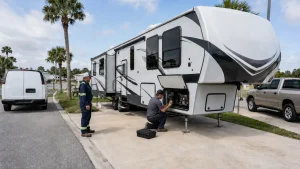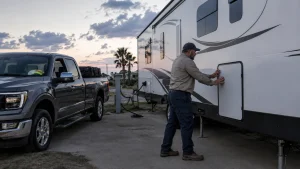
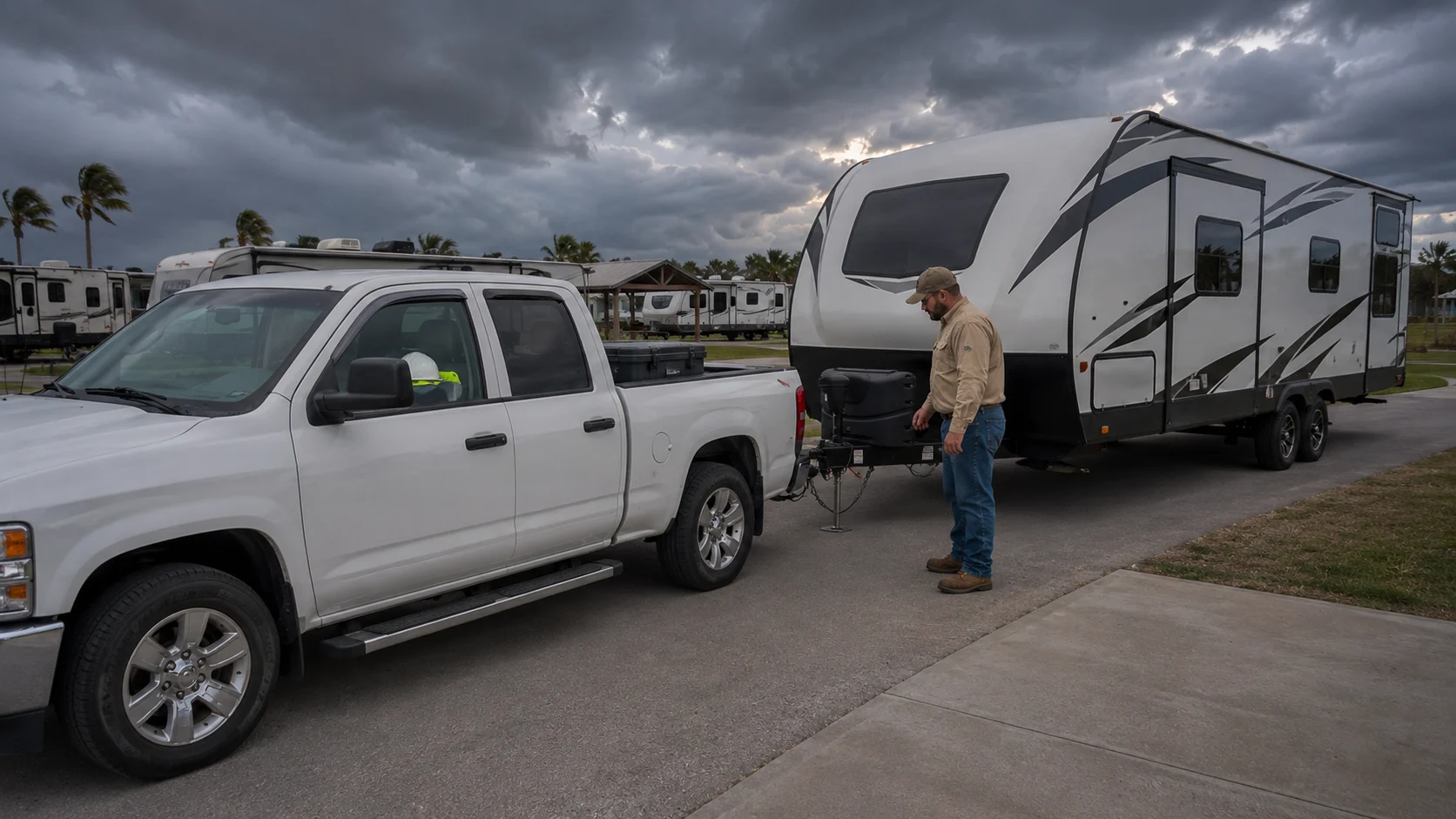
An RV should never be treated as a hurricane, tornado, or severe-wind shelter. During Gulf Coast weather, the first decision is not how to protect the trailer. It is how to protect the people and pets who are staying in it.
A refinery assignment can complicate that decision because work schedules, badging, reporting instructions, and housing arrangements may all be changing at the same time. Those details matter, but they come after official weather and evacuation instructions.
The safest plan is made before conditions deteriorate. Depending on the hazard, that may mean relocating the complete pickup-and-RV combination, leaving the RV and evacuating in another vehicle, or moving immediately to a nearby sturdy shelter without attempting to tow at all.
| Decision priority Protect people and pets first. Follow official instructions second. Deal with the RV, reservation, and work assignment only after the life-safety decision is clear. |
Start With the Type of Weather Threat
“Gulf Coast storms” can describe hazards that develop on very different timelines. The response that is reasonable for a tropical system several days away may be dangerous during a tornado warning or rapidly rising floodwater.
Tropical storms and hurricanes
The National Weather Service generally issues a hurricane watch about 48 hours before anticipated tropical-storm-force winds and a hurricane warning about 36 hours before those winds. A watch is a planning and decision period. A warning means preparations should be nearly complete and local instructions must be followed immediately.
Do not wait for the forecast cone, watch, or warning alone to make every decision. Storm surge, inland flooding, tornadoes, road closures, evacuation zones, and local orders may create a different timeline for Brazoria County than the wind forecast suggests.
Tornadoes and sudden severe wind
A tornado or severe-wind warning is not the time to begin hitching or loading an RV. National Weather Service campground guidance emphasizes knowing where a sturdy shelter is located and acting promptly when a warning is issued. Leave the RV for substantial shelter when it is safe to do so; do not attempt to tow through an immediate warning.
Flash flooding and blocked roads
Heavy rain may make the route unsafe even when wind conditions appear manageable. A storm plan must include the possibility that the road to the intended destination will close or flood before the rig can move.
Use Alerts as Planning Triggers, Not Automatic Towing Orders
Official alerts should change your planning posture, but they do not automatically prove that towing is safe or that every guest must take the same action.
- No active tropical threat: keep the tow vehicle and RV roadworthy, maintain current documents, and know where occupants and the rig could go.
- A tropical system is being monitored: verify employer communications, fuel, pet arrangements, possible destinations, and whether the full rig can be accepted.
- A watch is issued: decide whether the RV will move or remain, confirm the route and destination, and leave early if relocation remains appropriate.
- A warning is issued: complete only the remaining actions that can still be done safely. Do not begin planning from scratch.
- An evacuation order or unsafe local condition exists: leave as directed. Do not delay for the trailer or attempt to tow through wind, floodwater, blocked roads, or severe congestion.
- After the storm: return only when authorities, roads, the park, and the condition of the RV support safe access.
Move the RV Only When Four Conditions Are Satisfied
Relocating the complete rig can preserve housing and personal property, but towing adds weight, length, crosswind exposure, stopping distance, and route limitations. The RV should move only when all four conditions below are satisfied.
1. No known or suspected towing-safety defect exists
Treat the following as stop signs, not as a complete roadworthiness inspection:
- Tire damage or abnormal pressure loss
- Wheel, hub, axle, brake, or suspension concerns
- Hitch, coupler, pin-box, safety-chain, or breakaway-system damage
- Trailer-light or electrical-connector failure
- Frame, structural, or major slide-out damage
A visual check cannot certify every component. If a safety-related defect is known or suspected, do not tow until the appropriate technician, roadside provider, manufacturer, or repair facility determines that the rig can be moved.
2. The destination has accepted the complete setup
Confirm the RV type and length, vehicle count, pets, arrival window, utility expectations, and any route or clearance limitation. Do not assume that a hotel, shelter, truck stop, or commercial parking lot will accept a fifth-wheel or travel trailer.
3. The route remains open and suitable for the rig
A route that works for a pickup alone may contain low clearances, tight turns, weight restrictions, flooding, closures, or congestion that makes towing impractical.
Review Brazoria County emergency-preparedness resources for current evacuation information and use DriveTexas to check current Texas road conditions, closures, construction, and flooding before departure. Saved routes are not guarantees; conditions and law-enforcement directions may change.
4. The driver can depart before conditions deteriorate
The driver must be rested enough to control the full combination and able to leave before wind, visibility, rain, flooding, or evacuation traffic removes the safe travel window. There is no universal wind speed that makes every RV combination safe or unsafe. Tow vehicle capability, loading, trailer profile, crosswind direction, road exposure, and manufacturer limitations all matter.
Leave the RV When Towing Would Increase the Risk
Evacuate the occupants without the trailer when the destination cannot accept it, the route is no longer suitable, the safe departure window has passed, the driver is too fatigued, officials direct immediate evacuation, or a towing-safety defect has not been professionally cleared.
The decision hierarchy is simple: people, pets, medication, and dependable transportation leave first. The RV is secondary.
An employer may continue, suspend, or restart the turnaround on a different timeline. That decision does not determine whether the RV park, route, or trailer is safe. Local evacuation and life-safety instructions determine when you leave. Employer instructions determine when and where you report afterward.
When the Complete Rig Is Relocating
Once relocation remains safe and the destination has accepted the rig, complete the departure in a controlled sequence:
- Obtain the latest official employer reporting instruction without allowing it to delay evacuation.
- Confirm that the destination still accepts the RV, occupants, vehicles, and pets.
- Check current evacuation and road information immediately before departure.
- Retract the awning and store loose exterior items.
- Secure doors, windows, roof vents, compartments, and loose interior objects.
- Disconnect water, sewer, and electricity according to manufacturer instructions and current park directions.
- Check the hitch or coupler, chains, breakaway cable, electrical connector, lights, tires, and obvious brake warnings.
- Load medication, identification, insurance documents, keys, phones, water, pet supplies, and work essentials.
- Leave before wind, flooding, visibility, or traffic conditions become unsafe.
If you are staying with us, use the Stone Bridge Contact page to discuss how removing the RV may affect the assigned site, billing, or later return. Do not assume that an empty pad will automatically remain reserved while the rig is away.
Prepare a Departure Set Before the Weather Becomes Urgent
The purpose is not to pack every household item. It is to keep the documents and supplies most likely to affect evacuation, employment, medical needs, and recovery together.
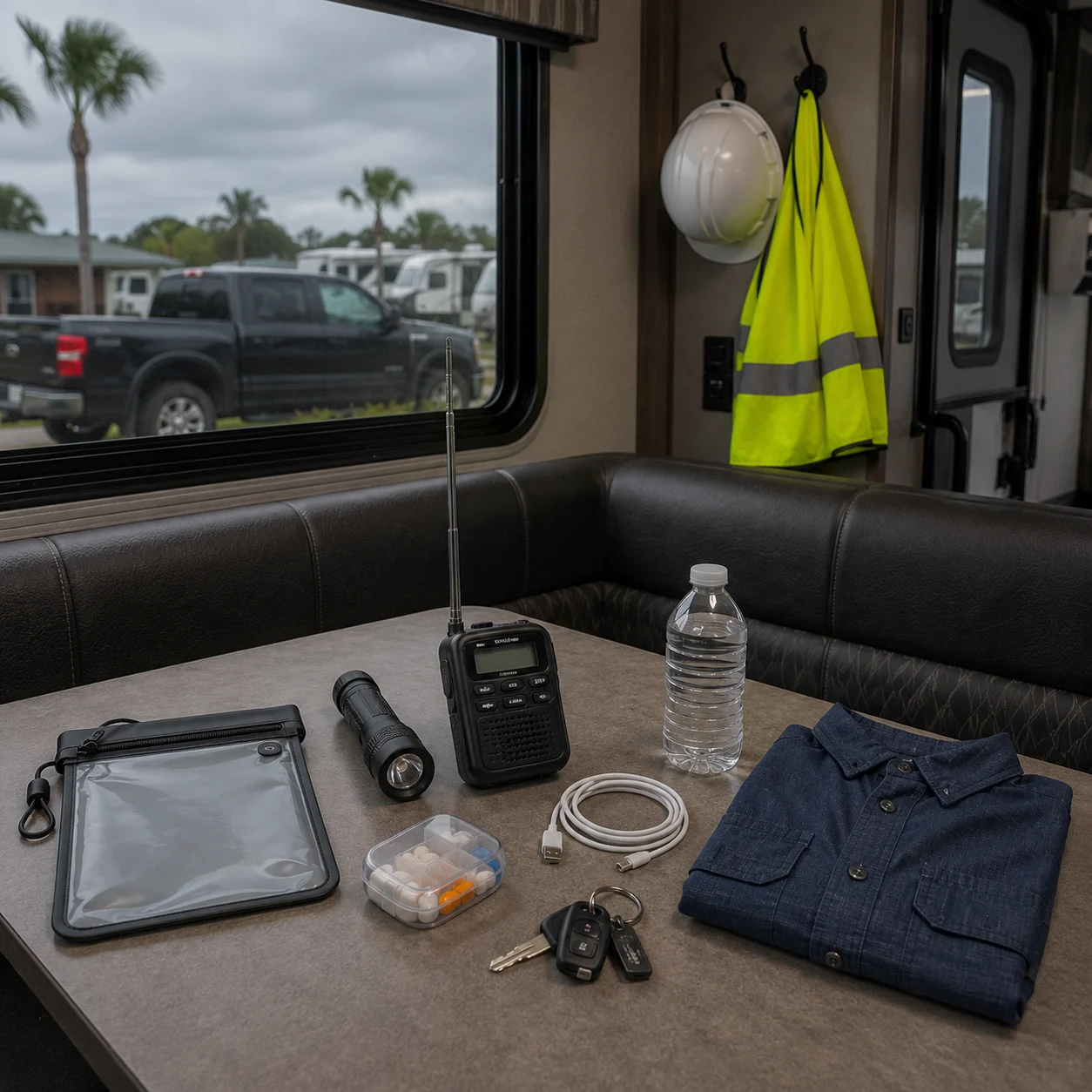
Personal and medical
- Government identification
- Medication and prescription information
- Phone, charging equipment, and backup power
- Water, essential clothing, and toiletries
Pickup and RV
- Registration and insurance documents
- Roadside-assistance information
- Pickup and RV keys
- Current photographs of the rig and site
Refinery assignment
- Work badge or identification
- Required PPE
- Supervisor, dispatch, or contractor contacts
- Current reporting and payroll or travel instructions
Pets
- Leash or carrier
- Food, water, and medication
- Vaccination or veterinary documentation
- A destination that has confirmed pet acceptance
If the RV Must Stay Behind
The objective is to remove avoidable hazards without delaying departure. No last-minute securing method can make an RV hurricane-proof or safe against tornado winds, flooding, falling trees, or airborne debris.
Complete only actions that remain safe:
- Retract the awning.
- Store chairs, mats, grills, hoses, tools, bicycles, and loose equipment.
- Close and latch exterior compartments, windows, and roof vents.
- Secure loose interior objects and follow manufacturer instructions for slide-outs.
- Disconnect utilities when required by the departure plan, manufacturer instructions, or current park direction.
- Shut down appliances according to manufacturer instructions.
- Remove trash from the site.
- Take documents, medication, keys, valuables, pet supplies, and work identification.
- Photograph the RV and site before leaving.
Do not tie the RV to trees, attach straps to a utility pedestal, improvise ground anchors, park a pickup against the trailer, remain inside to protect it, or delay an evacuation order for nonessential work.
Our current park policies require assigned sites to remain safe, clean, and orderly and prohibit leaving trash outside the RV. Storm-specific instructions can vary by event, so contact management directly rather than assuming standard policies answer generator, site-retention, or reentry questions.
Never Enter Floodwater or Bypass a Barrier
A large pickup and four-wheel drive do not make moving water safe. The safest rule is categorical: do not drive or walk into floodwater, and never go around a road barrier.
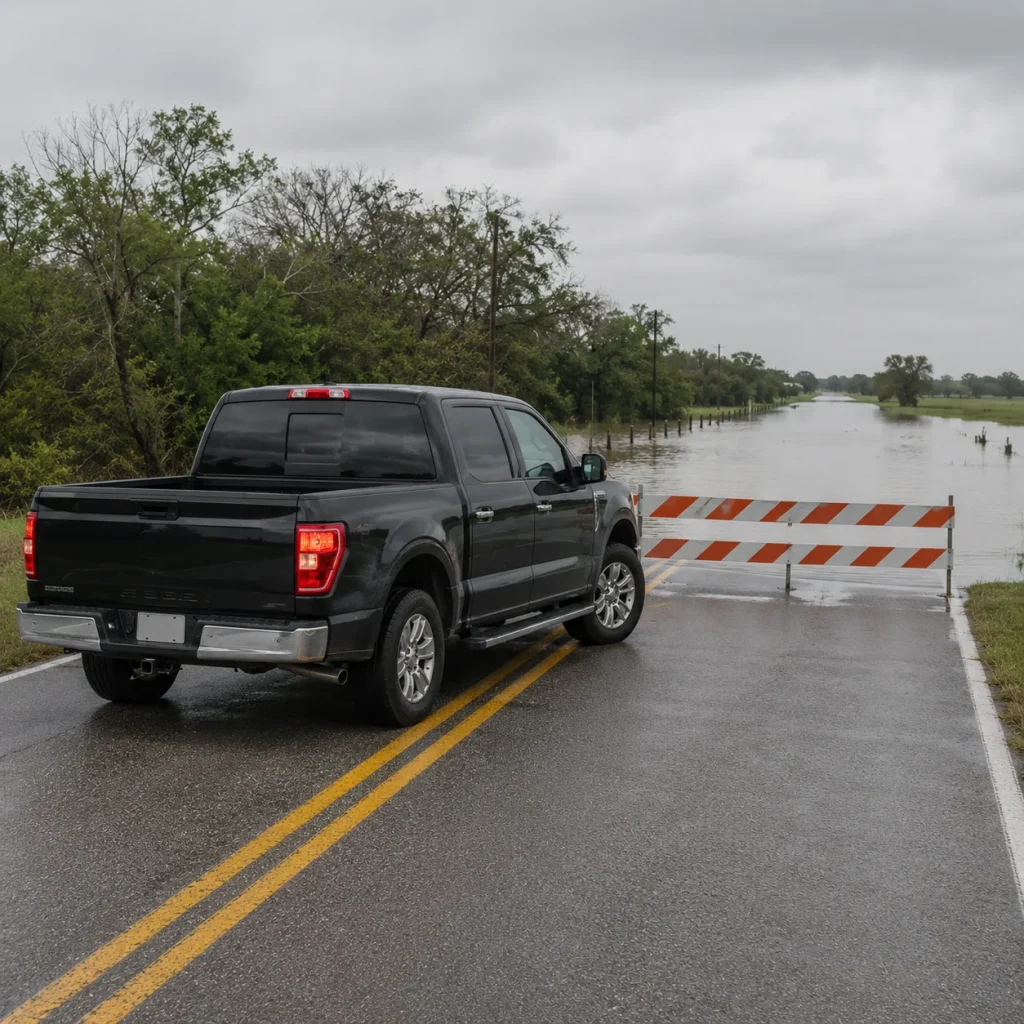
National Weather Service flood-safety guidance warns that 12 inches of rushing water can carry away many cars and about two feet can carry away SUVs and trucks. Those figures illustrate the force of water; they are not safe crossing thresholds.
When a route is blocked:
- Stop on dry pavement and remain clear of the flooded section.
- Follow emergency-management or law-enforcement instructions.
- Use a currently approved alternate route.
- Do not estimate depth from inside the pickup.
- Do not follow another vehicle into the water.
Do Not Assume a Portable Generator Can Be Used at the Site
Generator use depends on park permission, dry outdoor placement, fuel handling, and the ability to keep exhaust away from every RV—not only your own.
CDC carbon-monoxide guidance says portable generators should be operated outdoors more than 20 feet from windows, doors, and vents and used with a battery-powered or battery-backup carbon-monoxide detector.
In an RV park, that distance may be impossible without placing the generator near another guest’s window, in an internal roadway, beside utility equipment, or in standing water. A carbon-monoxide detector is a backup warning device; it does not make unsafe placement acceptable. When the required separation cannot be achieved, do not operate the portable generator at that site.
Do not assume generator use is allowed. Obtain current instructions from park management before operation.
Know Which Authority Controls Each Decision
Storm planning becomes clearer when each decision is assigned to the correct source:
- National Weather Service and National Hurricane Center: forecasts, watches, warnings, and hazard information.
- Local emergency management and law enforcement: evacuation zones, orders, local routes, and return permissions.
- TxDOT and current roadway authorities: road closures, flooding, damage, and traffic conditions.
- Stone Bridge management: site access, park-side utilities, reservation status, generator permission, and reentry to the property.
- The employer or contractor: shift cancellation, relocation, reporting, and reimbursement.
- The RV manufacturer or qualified technician: equipment procedures and whether suspected damage permits safe towing or occupancy.
Do not remain in an RV because the next shift has not yet been cancelled, and do not assume a return-to-work notice means the road or RV park is ready for reentry.
Return Only After the Route, Park, and RV Are Safe
The storm passing does not automatically make the site safe to occupy. Before returning, confirm that local authorities permit access, the route is open, no floodwater blocks the way, and the park is accepting reentry.
After arrival, begin with an exterior warning-sign check:
- Fallen trees, branches, or power lines
- An RV that shifted from its previous position
- Propane or fuel odor
- Visible pedestal, shore-cord, or utility damage
- Standing water around electrical equipment
- Roof, window, slide-out, frame, or exterior-panel damage
A visual inspection cannot prove that electrical, propane, structural, or towing systems are safe. Do not energize wet equipment, reconnect damaged utilities, enter an RV with a suspected propane leak, or move a damaged trailer until the park and the appropriate professional have cleared the parts they control.
Photograph visible damage before cleanup when it is safe to do so. Address the repair, reservation, and employer schedule only after the immediate hazards are controlled.
Make the Storm Decision While Safe Options Still Exist
The strongest storm plan does not attempt to save every possession. It preserves the ability to act before weather, traffic, fatigue, or road conditions remove the safe choices.
- Protect people and pets.
- Follow official warnings, evacuation orders, and local instructions.
- Move the RV only when the rig, route, driver, and destination remain suitable.
- Leave the RV when towing would delay or endanger evacuation.
- Coordinate the reservation and work assignment after the safety decision.
- Return only after the route, property, utilities, and RV support safe access.
Long-term guests should save our contact information before tropical weather develops and use the Stone Bridge Contact page for current site-specific instructions. The park’s website and public phone number do not replace a weather warning, evacuation order, emergency service, or direct instruction from local authorities.
Frequently Asked Questions
Do not rely on an RV as protective shelter during tornado or severe-wind conditions. Know where a sturdy shelter is located and move promptly when official warnings or local instructions require action.
Not automatically. A watch is the time to decide and prepare. Tow only when no suspected safety defect exists, the driver is rested, the destination has accepted the rig, the route remains suitable, and departure can occur before conditions deteriorate.
Contact management for the current event-specific answer. Do not assume that an unattended RV will be protected, that the assigned site will remain available, or that immediate post-storm access will be permitted.
Only when the park permits it and the manufacturer and CDC separation requirements can be met without exposing your RV, a neighboring RV, people, pets, roadways, or utility equipment. When safe placement is not possible, do not operate the generator at the site.