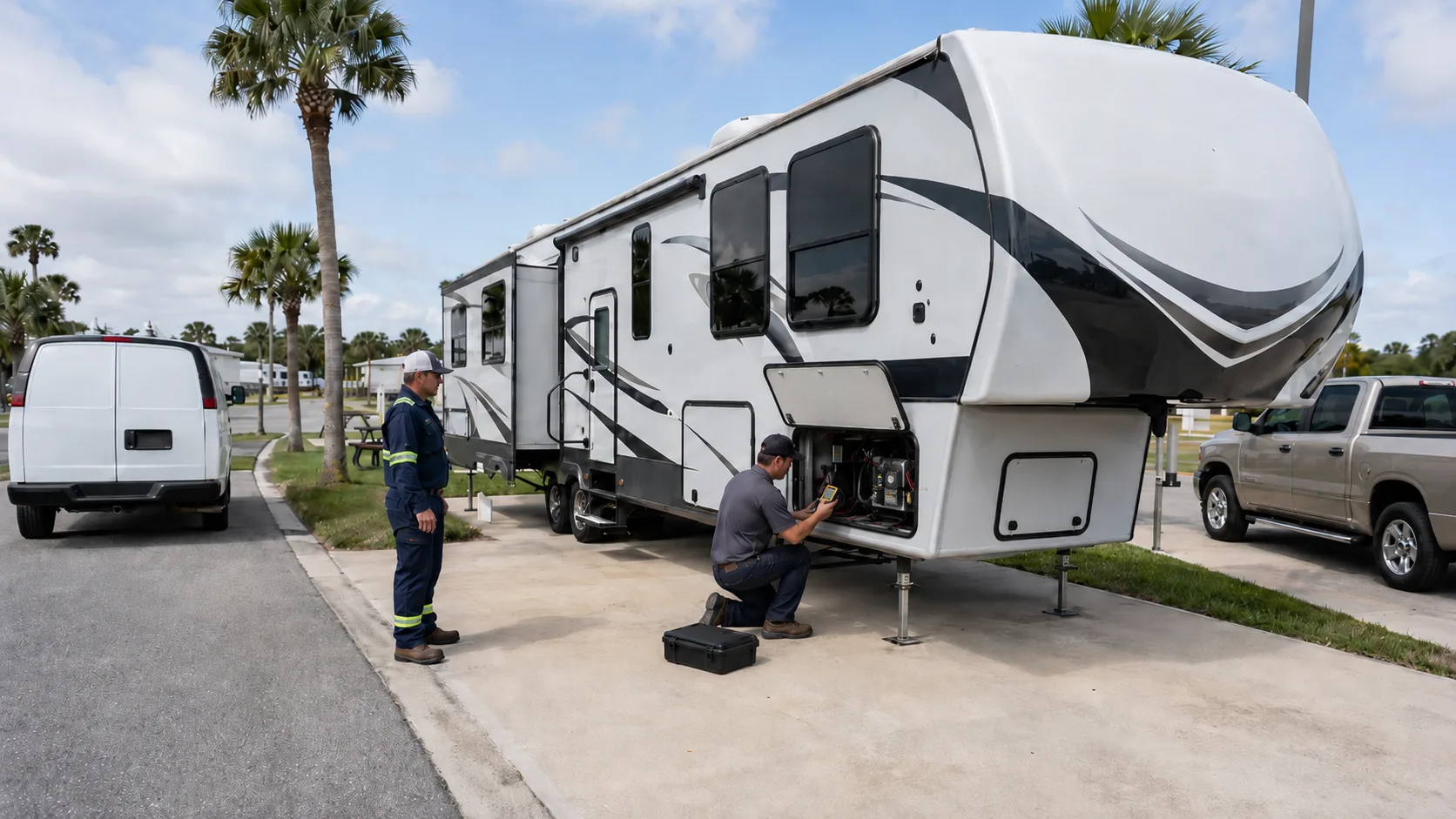
An RV failure during a turnaround assignment can create three separate problems at once: a safety problem, a housing problem, and a work-schedule problem. The next shift may be approaching, but the repair decision must begin with the condition of the RV – not with the pressure to keep the assignment routine unchanged.
Before authorizing work, determine which of these situations applies:
- There is an immediate hazard and the RV must be evacuated.
- There is no immediate emergency, but a qualified professional must determine whether the RV is safe to occupy or move.
- The failure is isolated, nonessential, and can be safely shut down while routine service is arranged.
Do not tow, re-energize, reconnect, or continue using a damaged system simply because the work schedule is difficult to interrupt.
Triage the Failure Before Choosing the Repair Path
| What you observe | Immediate response |
| Fire, visible smoke, active electrical arcing, strong suspected propane leak, carbon-monoxide alarm, or an injury emergency | Leave the RV, move away from the hazard, and call emergency services from a safe location. |
| No immediate emergency, but you cannot determine whether the RV is safe to occupy or move | Keep the affected system off, avoid towing, and obtain an assessment from the appropriate qualified professional. |
| An isolated, nonessential failure that can be safely shut down without an active leak, odor, overheating, sewage release, or structural concern | Remain onsite if the RV is otherwise habitable and schedule the appropriate repair. |
A worker can identify visible symptoms and stop using an affected system. Technical safety decisions may require a mobile RV technician, tire or axle specialist, roadside provider, manufacturer-authorized service center, electrician, propane professional, or another appropriately qualified provider, depending on the failure.
Immediate life-safety hazards
Leave the RV immediately when there is fire, visible smoke, active electrical arcing, a strong suspected propane leak, a carbon-monoxide alarm, or another immediate threat to life. Move away from the rig and call emergency services from a safe location. Do not remain inside to investigate, reset equipment, or protect belongings.
A collision involving injuries also requires emergency assistance. Notify park management only after emergency help has been requested and it is safe to do so.
Urgent conditions that may make the RV uninhabitable
Some failures require prompt relocation and professional service without automatically becoming a 911 call. Examples may include sewage entering the living area, major uncontrolled water intrusion, loss of safe sanitation, or cooling failure when the interior cannot be maintained at a safe temperature for the occupants or pets.
Leave the affected space, isolate the system only when you can do so safely and according to manufacturer guidance, and arrange the appropriate repair or remediation. Call emergency services if exposure, illness, fire, gas, electrical danger, or another immediate threat develops.
Isolated nonessential failures
The RV may remain usable when the problem is limited, no active hazard continues, and the affected system can be safely switched off or isolated. Examples may include a failed television, a nonessential appliance, a refrigerator that stops cooling, or one plumbing fixture that a qualified person has determined can remain isolated.
A refrigerator failure may require moving food to a cooler and scheduling service. It does not automatically require towing the entire RV to a shop. The condition of the specific system should determine the repair path.
Do Not Move the RV When Towing Safety Is Uncertain
A worker should not attempt to preserve the assignment schedule by towing a mechanically uncertain RV. Stop and obtain professional assessment when the problem may involve:
- Tires, wheels, or hubs
- Axles, brakes, or suspension
- Hitch, coupler, pin-box, safety-chain, or breakaway components
- Frame or structural damage
- Major slide-out damage or a component that cannot be secured for travel
- Collision damage or abnormal movement of the trailer
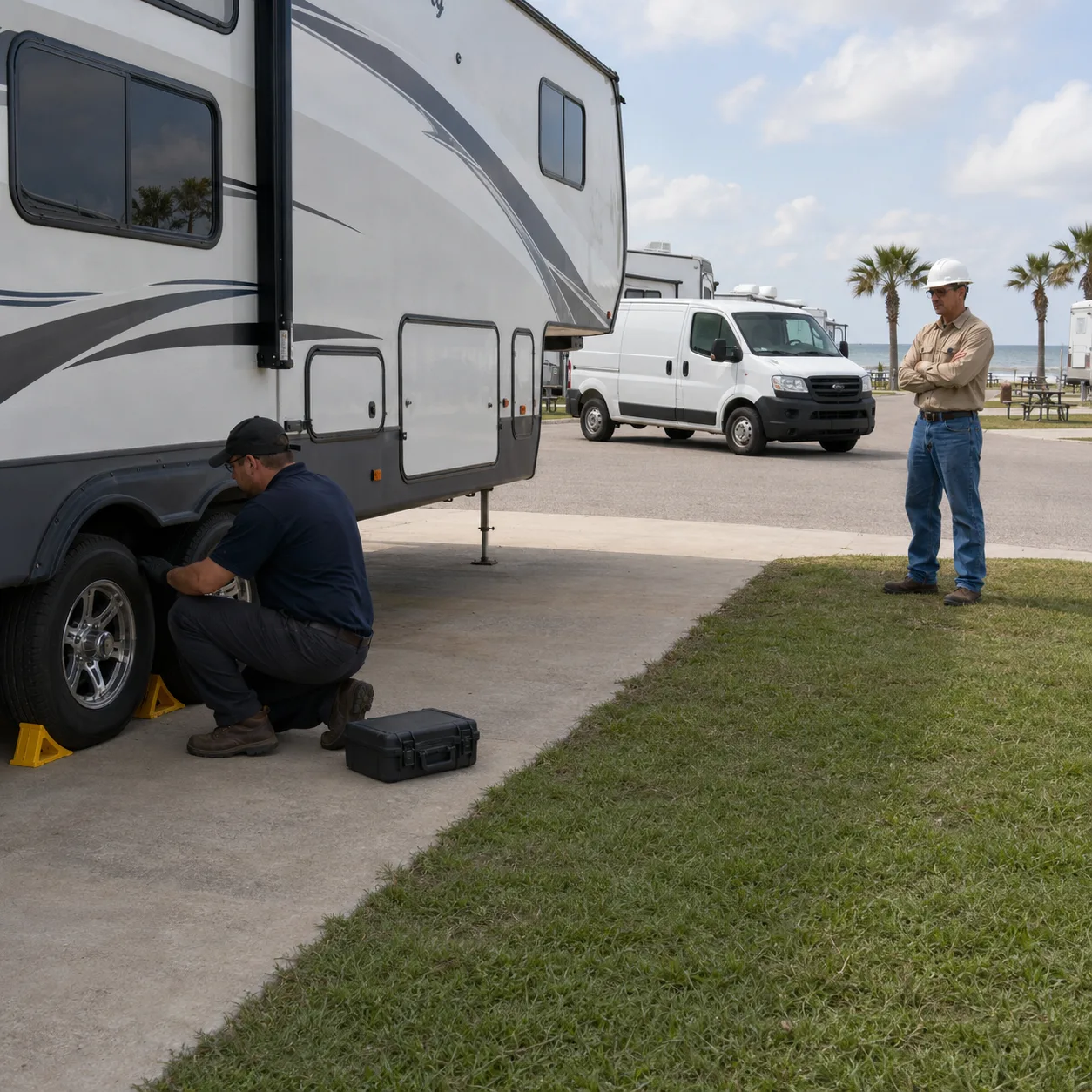
The appropriate provider may be a tire service, roadside-assistance company, axle or suspension specialist, mobile RV technician, authorized service center, or professional transport company. A mobile technician may be able to inspect the RV onsite even when the final repair requires shop equipment.
Choose Mobile Service, Shop Repair, or Temporary Relocation
Mobile service may work when
- The RV can remain safely parked at the site
- The affected component is accessible onsite
- The work does not require a lift, alignment rack, major fabrication, or extensive disassembly
- The service vehicle and repair activity can be accommodated without blocking the road or another site
- Any needed utility interruption can be coordinated safely
Shop repair or professional transport may be required when
- The repair needs specialized equipment that cannot be brought to the site
- The RV cannot be safely moved under its own normal towing arrangement
- The manufacturer, warranty provider, insurer, or service contract requires an approved facility
- The work would create unsafe noise, debris, fluids, traffic, or access conditions at the site
Temporary accommodation may be necessary when
- The interior is not safe or sanitary to occupy
- Essential electrical, water, heating, or cooling systems will remain unavailable
- The repair requires the RV to be disconnected or inaccessible for an extended period
- Occupants or pets cannot remain safely in the current conditions
Confirm Onsite Service Arrangements With the Park
Our public policies do not create automatic approval for every outside repair provider or every type of onsite work. Before scheduling mobile service, contact our office so we can confirm whether the proposed work can be accommodated and what site-access or parking instructions apply.
Be prepared to explain:
- The technician or company name
- Expected arrival window
- Type of repair or inspection
- Size of the service van, roadside vehicle, or transport equipment
- Whether the technician needs interior access
- Whether utilities must be disconnected
- Whether parts, packaging, fluids, or damaged material will be removed
- Whether the work may extend beyond the scheduled appointment
Guest vehicle limits do not automatically answer where a temporary service van or transport vehicle may park. Confirm the arrangement before the provider arrives rather than allowing the repair to create a second access or traffic problem.
Use the Stone Bridge Contact page to discuss technician access, park-side utility coordination, service-vehicle parking, or a possible removal of the RV before the appointment is finalized.
Give the Technician the Information Needed for the First Visit
A well-prepared service request can reduce a wasted trip. Send the identifiers and evidence requested for the affected system, which may include:
- RV year, manufacturer, model, and type
- RV VIN, chassis VIN, appliance serial number, tire size, or component model number when relevant
- Exact symptom and when it began
- Error code or warning message
- Whether the problem is continuous or intermittent
- Photos or a short video of the affected component and surrounding area
- What has already been safely switched off or isolated
- The park address, site number, and available access window
Do not dismantle a system or repeatedly reset a breaker, alarm, or appliance merely to produce more information. Describe what you observed and allow the appropriate professional to determine the diagnostic procedure.
Control Repair Access While You Are on Shift
A service appointment may overlap with a 10- or 12-hour refinery shift. Decide how access and repair authorization will be controlled before the technician arrives.
Be present when possible
Being present is usually the clearest option when interior access is required, valuables or work documents remain inside, the likely cost is uncertain, or the technician may need immediate approval for additional work.
Authorize one trusted adult when necessary
The authorized person should know:
- The technician’s name and expected arrival window
- Which areas of the RV may be entered
- Whether pets will be removed or secured elsewhere
- The diagnostic amount already approved
- The maximum dollar amount authorized before the worker must be contacted
- Whether parts replacement requires separate approval
- How keys will be controlled and returned
Reschedule when access cannot be controlled
Do not leave a key in an uncontrolled location or authorize open-ended repairs because the shift makes communication inconvenient. Reschedule when nobody can provide lawful access, the technician requires decisions that cannot be made remotely, or the park-side access arrangement has not been confirmed.
Do not assume our staff can hold the RV key, supervise a private technician, authorize additional work, or accept responsibility for the repair. Any such arrangement would need to be discussed and expressly confirmed in advance.
Move Out Temporarily When the RV Cannot Be Occupied
When the RV must remain parked but cannot be safely or practically occupied, separate the temporary housing decision from the repair schedule. Take the items needed to continue reporting for the assignment:
- Government identification and assignment documents
- Medication and prescription information
- Required PPE, work badge, and work clothing
- Phone, chargers, and essential toiletries
- Food that may spoil if refrigeration has failed
- Pet food, medication, carrier, leash, and other essential supplies
- RV, insurance, warranty, and roadside-assistance documents
- Keys or access materials specifically authorized for the technician
Before leaving, secure the RV and exterior compartments, remove or protect perishable food, confirm who may enter, and ask the park how an unoccupied RV should be handled during the repair period.
Stone Bridge offers cabins and Oak Lodges as separate lodging options. Their availability, occupancy limits, rates, and suitability during a repair must be confirmed directly; they are not automatically reserved for a guest whose RV becomes unusable.
Confirm the Reservation Before the RV Leaves the Property
Taking the RV to a repair facility does not automatically answer what happens to the assigned pad. Before the RV is moved, ask the park to confirm in writing:
- Whether the reservation remains active
- Whether rent continues while the RV is away
- Whether the same site will be held
- Whether a final electricity reading is required
- Whether utilities must be disconnected in a particular way
- Whether the pickup or other vehicle may remain
- The expected return date and what happens if the repair is delayed
- What approval is required before the RV returns to the property
Public site-assignment and extension policies do not establish a complete procedure for an RV that temporarily leaves for repairs. Obtain the specific answer before transport begins – not after the shop changes the completion date.
Check Coverage and Authorization Before Major Non-Emergency Work
After the immediate hazard has been controlled, identify every potentially applicable coverage source and follow its notice, provider, and preauthorization rules. Depending on the failure, those sources may include:
- The RV or component manufacturer’s warranty
- An extended service contract
- Roadside-assistance coverage
- Vehicle, trailer, or property insurance
- A manufacturer-authorized repair program
- The employer’s temporary-lodging, mileage, or travel-reimbursement policy
Do not delay evacuation, emergency assistance, or required stabilization while researching coverage. For non-emergency major work, request a written diagnosis, written estimate, authorization number when applicable, expected completion date, and a clear rule for additional charges.
Retain photos, diagnostic reports, estimates, invoices, transport receipts, replaced-part information, and temporary-lodging receipts. These records may be needed by the warranty provider, insurer, employer, or repair facility.
You can also use the official NHTSA recall search to check for open recalls involving a vehicle, tire, trailer, or other covered equipment. A recall search can identify a known safety issue; it does not diagnose the current failure or replace the technician’s assessment.
Protect the Assignment Without Ignoring the Failure
The goal is to keep the repair from becoming a second housing or reservation problem – not to force the RV back into service before it is safe.
Use this order:
- Leave and call emergency services when there is an immediate life-safety hazard.
- When safety is uncertain, keep the affected system off and obtain the appropriate professional assessment.
- Choose mobile service, shop repair, professional transport, or temporary accommodation based on the actual failure.
- Confirm park access and service-vehicle arrangements before onsite work.
- Control technician access and repair authorization while you are on shift.
- Confirm the reservation before the RV leaves the property.
- Handle warranty, insurance, recall, and employer reimbursement after immediate safety needs are addressed.
For guests on an extended assignment, our long-term stay information explains the RV-site options available at Stone Bridge. Repair access, temporary lodging, and reservation status still need to be confirmed for the specific situation.
Frequently Asked Questions
Possibly, but do not schedule unattended access without a controlled key arrangement, clear repair authorization, and confirmation of the park-side access and parking plan. Do not assume park staff will supervise the technician or approve added work for you.
The worker can identify visible warning signs and stop the move. When towing safety is uncertain, the decision should come from the appropriate qualified professional for the affected tire, axle, brake, hitch, suspension, frame, or structural system.
Do not assume that it will. Before the RV leaves, contact the park and obtain written confirmation of whether the reservation remains active, whether rent continues, and whether the same site will be available when the RV returns.
Safety note: This article provides general planning guidance and does not replace emergency instructions, manufacturer procedures, or an assessment by the appropriate qualified professional.