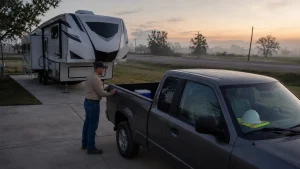

Reserve the RV site for the complete period you expect to be in the area—not only the scheduled workdays.
Your check-in date should come before the first obligation that requires you to be onsite and ready. Your check-out date should come after the final work, checkout, or demobilization obligation and allow enough time for a realistic departure.
There is no universal turnaround length or fixed number of buffer days. The practical answer comes from identifying the first required obligation, the last required obligation, and the time needed to travel, set up, rest, and leave safely.
Start With the First Required Work Obligation
Do not automatically use the first scheduled shift as the RV check-in date. Orientation, badging, contractor onboarding, safety training, or credential pickup may require you to be in the area earlier.
Identify the earliest time you must report, then work backward far enough to account for:
- The towing distance and expected travel time
- The park check-in or approved arrival process
- Time to position, level, and secure the RV
- Essential utility connections and first-night setup
- A reasonable rest period before orientation or the first shift
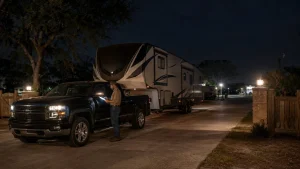
For many workers, arriving the afternoon or evening before an early orientation is more practical than trying to travel, park, connect, and report within the same morning. A longer trip, a large fifth-wheel, an after-hours arrival, or an unfamiliar setup may require more time.
Set the Check-Out Date After the Last Genuine Obligation
The final scheduled shift may not be the moment you can realistically leave the area. The assignment may still require tool return, contractor checkout, final paperwork, a safety meeting, or demobilization instructions.
The end of the last shift also may not be the right time to begin a long towing trip. OSHA notes that extended and irregular shifts can contribute to worker fatigue, so a departure plan should leave enough time for rest when the final shift ends late or overnight.
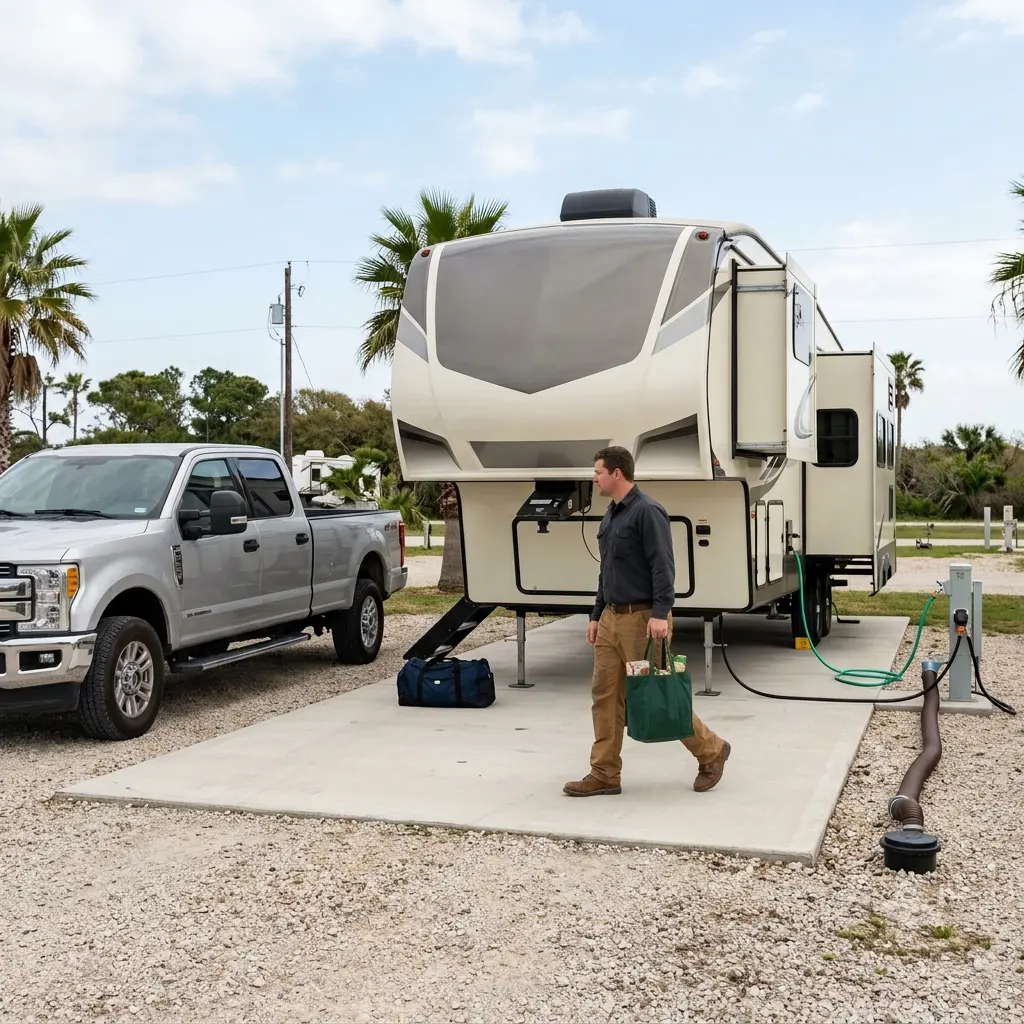
Choose a check-out date that follows the last real obligation and gives you enough time to disconnect, secure the rig, and leave under conditions you can manage safely. Confirm the park’s current check-out requirements before finalizing that date.
Calculate the Stay in Nights, Not Workdays
Once the arrival and departure boundaries are clear, calculate the reservation as one continuous stay:
| Planned stay Pre-work arrival time + confirmed assignment period + realistic post-work departure time Then count the actual nights from check-in through the night before check-out. |
This prevents a common mistake: treating a four-week work schedule as exactly four weeks of lodging even though the worker must arrive before the first work obligation and may not be able to leave immediately after the last one.
Example: a four-week assignment that requires 28 nights
Suppose orientation begins at 6:30 a.m. on Monday, August 3. The worker is towing from six hours away, so the practical check-in is Sunday, August 2. The final scheduled shift ends Friday evening, August 28, and contractor checkout occurs Saturday morning, August 29. The worker plans to rest and tow home on Sunday, August 30.
In that situation, the reservation runs from August 2 through August 30—a total of 28 nights. The exact dates will differ by assignment, but the method remains the same: begin before the first required obligation and end after the last realistic departure constraint.
Choose the Booking Term After You Know the Full Stay
Nightly, weekly, and monthly pricing are billing structures. They should be compared after the stay dates are calculated—not used to force the reservation into an artificial duration.
A weekly term may be more practical when the confirmed stay is short, the completion date remains uncertain, or a transfer is possible. A monthly term may be more practical when the full stay is several weeks and the total monthly cost is lower than repeated weekly charges.
Do not assume that monthly is automatically cheaper or that a four-week assignment automatically fits a monthly commitment. Compare:
- The total charge for the exact expected stay
- Required deposits and upfront cash
- Electricity billed separately
- Early-departure terms
- Extension availability
At Stone Bridge, we offer nightly, weekly, and monthly RV options. Review our current RV-site rates using the full planned stay rather than relying on an old quote or comparing only the advertised base rate.
Plan for an Uncertain End Date Without Guessing
An uncertain completion date creates two different risks. Reserving too little time may leave you without an extension or require a site move before the job is complete. Reserving too much time may create unused charges or a commitment that no longer fits the assignment.
Use the dates that are currently supported by the assignment, add only the arrival and departure time you can justify, and ask how the park handles extensions and early completion before you pay.
If the employer is discussing an extension but has not approved it, notify the park that additional time may be needed without treating the extension as confirmed. When the employer provides revised dates, request the exact additional nights and obtain an updated reservation confirmation.
At Stone Bridge, we ask guests to contact our office as soon as their stay may need to change. Extensions remain subject to availability, and the same site may not always remain available. Review our current park policies before booking so the extension and departure terms are understood in advance.

Confirm the Reservation in Writing
Before paying, make sure the written confirmation reflects the stay you actually calculated—not only the employer’s scheduled work period.
- Approved check-in and check-out dates
- Total number of nights
- Nightly, weekly, or monthly booking term
- Deposit and electricity arrangements
- Extension and early-departure procedures
- Site type and RV measurements
- Arrival instructions when arriving outside normal office hours
Keep the reservation confirmation, employer schedule, payment records, and park contact information together. If the assignment changes, those records make it easier to identify exactly what must be updated.
Choose Dates That Support the Assignment
The shortest possible reservation is not always the most practical, and the longest available term is not automatically the best financial decision.
A well-planned reservation should:
- Begin before the first genuine work obligation
- Continue through the confirmed assignment period
- Allow time for the last work or demobilization requirement
- Provide a realistic and rested departure window
- Use the billing structure that fits the complete stay
- Include a clear process for an extension or early finish
Once the expected dates are clear, use our online booking page to check current availability with the actual RV dimensions and planned stay. If the end date or vehicle arrangement still needs clarification, contact our team before completing the reservation.
Frequently Asked Questions
Yes, when the RV remains onsite and the stay continues through those days. The reservation is based on occupancy dates, not only the days you are scheduled to work.
Do not assume you must tow out immediately after the shift. Choose a check-out date that allows enough time to rest, disconnect the RV safely, and meet the park’s current departure requirements.
Base the initial reservation on the confirmed period plus a realistic arrival and departure window. Before paying, ask how extensions are handled and what happens if the same site is unavailable later.
No. Compare the total weekly and monthly cost for the exact dates, including deposits, electricity, early-departure terms, and the possibility that the assignment may change.