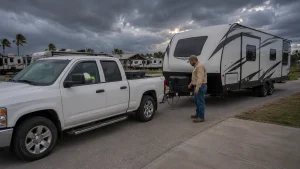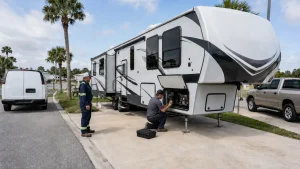
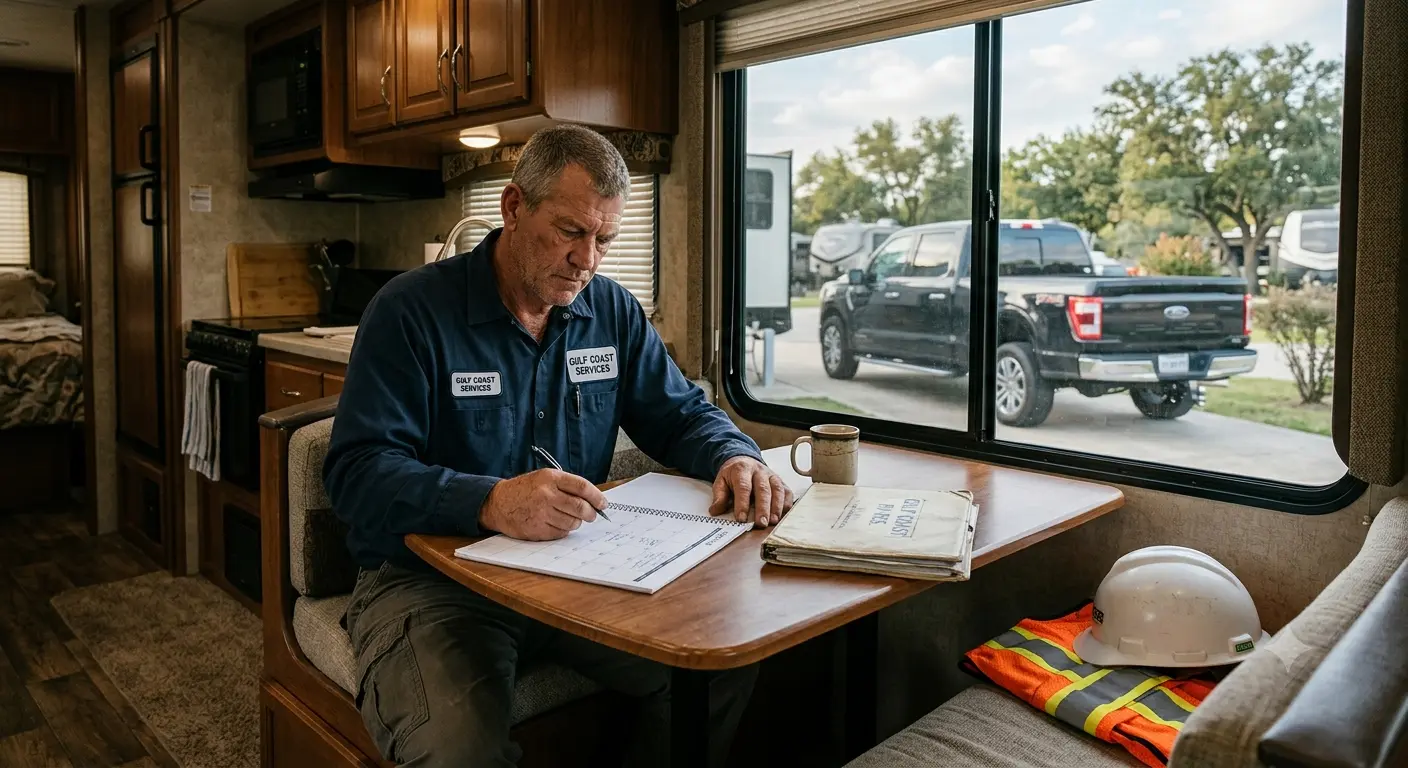
Once a refinery turnaround assignment becomes likely, your RV reservation should be planned around the work—not simply the projected start and completion dates.
A practical reservation should give you enough time to:
- Travel to the area
- Position and connect the RV
- Report to orientation or badging without rushing
- Remain through the expected assignment
- Adjust the stay if the project begins late, runs longer, or ends early
You may not know the final project schedule when you begin searching for a site. You should, however, know enough about the assignment, your RV, and your expected arrival to avoid booking a space that does not fit your needs.
Why Turnaround RV Reservations Require More Planning
A vacation usually has relatively fixed arrival and departure dates. A refinery or plant assignment may not.
Your mobilization date may depend on:
- Orientation
- Contractor onboarding
- Badging or credential pickup
- Safety training
- Facility access
- Changes in the project schedule
The expected completion date may also move as inspections, maintenance, repairs, and construction progress.
That uncertainty matters when you are reserving housing for several weeks rather than a weekend. A poorly planned reservation can leave you trying to extend at the last minute, moving sites during the assignment, or paying for a booking term that no longer matches the job.
Your reservation should support three priorities:
1. A realistic arrival window
2. A workable initial stay
3. A clear process for extensions, early completion, or reassignment
Confirm the Assignment Details Before Contacting an RV Park
You do not need every project date to be final before asking about availability. You do need enough accurate information for the park to identify a suitable site and explain the applicable terms.
Assignment information
Have the following details ready:
- Expected plant, facility, or work corridor
- Orientation, onboarding, or badging date
- Tentative first shift
- Estimated project duration
- Expected day, night, or rotating schedule
- Possibility of an extension
- Employer housing, reimbursement, or per-diem terms
- Likelihood of being transferred to another facility
Use the actual reporting location when it is available. A company name or nearby city may not identify the gate, contractor entrance, parking area, or shuttle point you will use each day.
RV and vehicle information
Also confirm:
- RV type
- Total RV length
- RV width
- Slide-out requirements
- 30-amp or 50-amp electrical service
- Tow-vehicle or pickup size
- Number of additional vehicles
- Utility or equipment trailer, if applicable
- Expected arrival time
- Preference or need for back-in or pull-through access
Do not guess your electrical requirement. Check the RV documentation before requesting a site. You can also review our guide to 30-amp and 50-amp RV service before choosing a site.
Accurate information helps prevent a situation in which the RV fits the pad but the work truck, slide-outs, utility connections, or turning approach do not.

Build a Reservation Window, Not Just Two Dates
Avoid using the employer’s projected first and final workdays as your exact RV check-in and check-out dates.
Plan the arrival around the first required obligation
Your reservation may need to begin before the first shift so you have time to:
- Complete the drive to the area
- Check in
- Position and level the RV
- Connect the essential utilities
- Obtain groceries or basic supplies
- Rest before orientation or work
For example, if orientation begins early Monday morning and you are towing from several hours away, arriving Sunday afternoon may be more realistic than attempting to travel, set up, and report within the same morning.
Plan the departure around the final obligation
The final scheduled shift may not be the moment you can leave.
The assignment may still require:
- Tool or equipment return
- Contractor checkout
- Final paperwork
- A safety meeting
- Demobilization instructions
- A late-night final shift
Your departure plan should also account for whether you will be rested enough to disconnect the RV and begin towing safely.
You do not need to add the same number of buffer days to every reservation. The goal is to base the dates on the complete assignment process rather than the most optimistic schedule.
Match the Site to the Assignment as Well as the RV
The correct site must accommodate the rig, but it should also work with the worker’s daily routine.
Consider:
- Whether the pickup can remain at the site
- Whether a second vehicle or trailer requires approval
- Whether you will leave before daylight or return late
- Whether you expect to arrive after office hours
- Whether backing the RV after a long drive will be difficult
- Whether the site allows safe access to the utilities and slide-outs
- Whether the commute remains practical after a long shift
A pull-through site may simplify arrival and departure for a large fifth-wheel or motorhome, particularly when the towing combination is difficult to maneuver. A standard back-in site may work just as well when the RV dimensions, vehicle arrangement, and driver preference support that setup.
Our current park policies allow one RV and up to two vehicles per site. Additional or overflow parking must be discussed with management before the reservation is completed.
Review the Complete Cost Before Committing
The advertised site rate is only one part of the housing decision.
Confirm the complete expected cost, including:
- Nightly, weekly, or monthly base rate
- Required security deposit
- Whether electricity is included or billed separately
- Internet availability
- Laundry expenses
- Additional-vehicle or overflow-parking terms
- Cancellation or reservation-change conditions
- Early-departure terms
- Fuel cost for the daily commute
Keep refundable deposits separate from the final housing cost. A deposit may eventually be returned, but it still affects the amount of cash required at move-in.
Also distinguish housing expenses from:
- Groceries and meals
- Fuel
- Tools and work supplies
- Propane
- Personal transportation
- Other assignment expenses
Use our current RV site rates when comparing costs. Live information is more reliable than an old screenshot, a previous quote, or a rate shared by another worker.
Understand How Reservation Changes Will Be Handled
Before paying a deposit, ask what happens when the assignment changes.
Confirm:
- Who should be contacted if the start date moves
- Whether the arrival date can be adjusted
- Whether the reservation can be extended
- Whether the same site will remain available during an extension
- What notice is required for an early departure
- How a transfer to another facility affects the booking
- What instructions are required for an approved late arrival
There is an important difference between notifying the park about a possible change and formally changing the reservation.
If an extension is being discussed but has not been approved, you can alert the park that additional time may be needed. Once the employer confirms the new dates, provide the exact number of nights requested and obtain written confirmation from the park.
At Stone Bridge, we ask guests to contact our office as soon as they know their stay may need to change. Extensions remain subject to availability, and the same site may not always be available.
Do not assume that:
- A conversation with the employer changes the RV reservation
- An availability inquiry holds a site
- Additional nights are guaranteed
- An apparently empty pad can be used
- Another worker can take over the remaining reservation
The park must approve the revised dates, site arrangement, and charges.
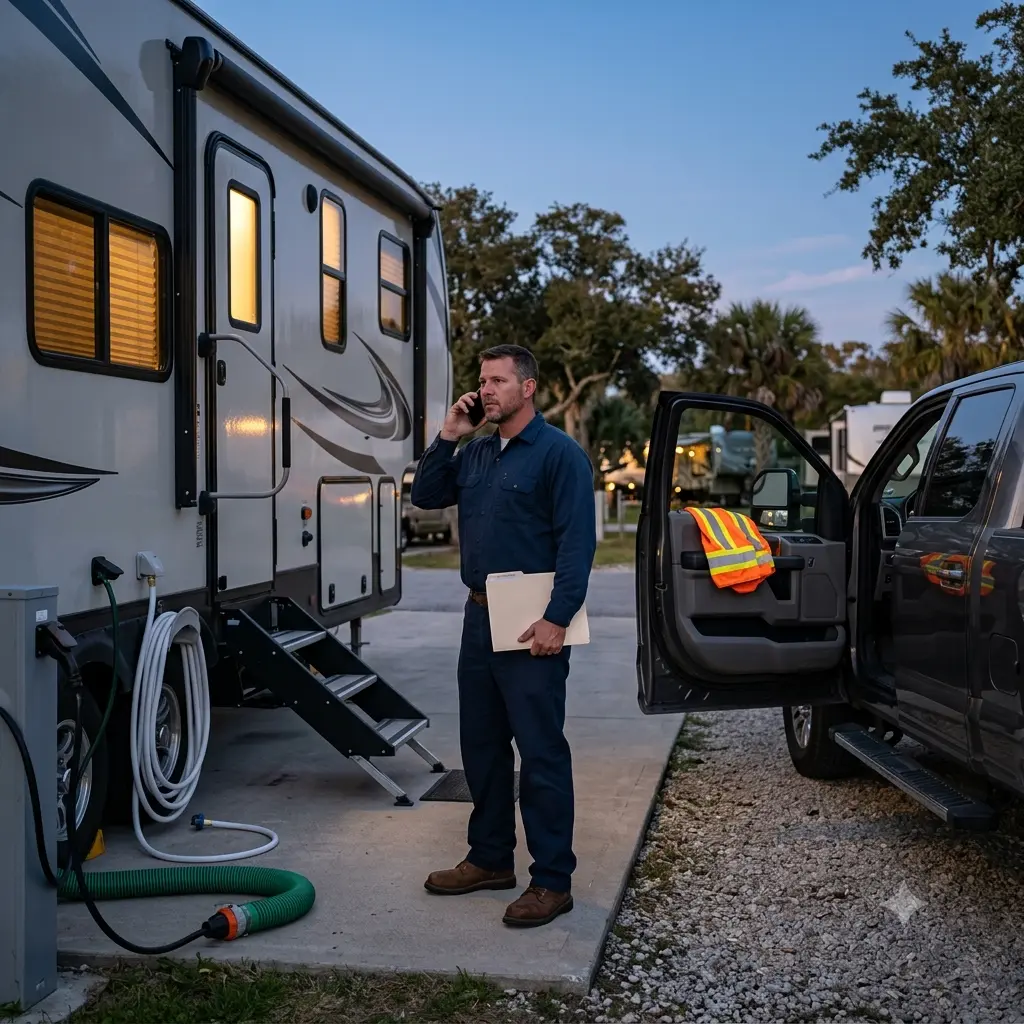
Confirm the Three Most Important Decisions Before Paying
A long list of details may be involved, but three decisions matter most before you commit.
1. Does the site fit the complete setup? Confirm the RV dimensions, electrical service, slide-outs, tow vehicle, additional vehicles, and any trailer or equipment.
2. Does the reservation window reflect the real assignment? The dates should account for travel, orientation, setup, the expected work period, demobilization, and a realistic departure.
3. Do you understand the full cost and change terms? Know what is due at booking, what is billed separately, and what happens if the project starts late, extends, ends early, or moves to another location.
Once those three decisions are clear, confirm the remaining details:
- Worksite and expected commute
- Check-in and check-out dates
- Booking term
- Deposit
- Electricity
- Vehicle arrangement
- Late-arrival instructions, if needed
- Extension process
- Early-departure terms
- Contact method for schedule changes
Keep the reservation confirmation, payment records, current park policies, and employer schedule in one place. Written confirmation is easier to use than information scattered across phone calls, messages, and screenshots.
Plan Around the Job, Not the Best-Case Schedule
A good reservation does not need to predict every project change.
It should provide:
- A suitable site for the complete rig
- Enough time to arrive and report without rushing
- A realistic initial stay
- A manageable commute
- A clearly understood cost
- A defined process for changing the booking
Workers preparing for refinery or plant assignments near Sweeny can review our long-term RV options and check current availability using the actual RV measurements and expected arrival period.
If any part of the assignment or vehicle arrangement remains uncertain, contact our team before paying rather than relying on an assumption.
Frequently Asked Questions
Yes. You can research availability using a probable arrival period and expected stay range. Explain that the project dates remain tentative, and confirm what can be changed before paying a deposit.
Reserve a realistic initial stay based on the dates currently supported by the assignment. Ask how extensions are handled, how much notice is helpful, and whether a site move may be required. Do not assume the existing site will remain available.
Provide the complete vehicle arrangement before the reservation is confirmed. Include the RV, tow vehicle, additional vehicles, utility trailer, equipment trailer, and any unusual parking or turning requirements. This allows the park to determine whether the site and approved parking arrangement can accommodate the full setup.