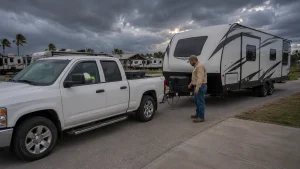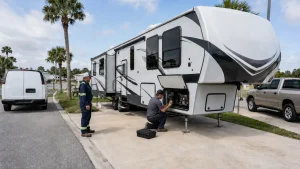
If you’re coming into Sweeny for refinery work, the goal is simple: show up, settle fast, sleep well, repeat. Long shifts don’t leave room for housing drama—spotty WiFi, unclear parking rules, loud neighbors, or a laundry room that’s never open when you need it.
This checklist is built for working folks who want a smooth month (or longer). Use it in two phases: before you book and during your first week. And if you’re staying at Stonebridge RV Park, I’ll point out exactly where their setup matches what refinery workers typically need—monthly options, full hookups, WiFi, and clear park policies.
“Fast answer” summary (for busy workers)
If you only have 60 seconds, this is what makes an RV stay smooth during a refinery run:
- Quiet + enforcement beats “nice amenities.” If you can’t sleep, nothing else matters.
- Parking rules must be clear. Work truck + second vehicle is common.
- WiFi must be tested on Day 1. Don’t assume it works everywhere.
- Laundry and showers should fit shift life. Your schedule won’t match “normal hours.”
- Monthly terms must be predictable. Know what’s included, what’s extra, and how electric is billed.
Everything below expands those points into a step-by-step approach you can use at any park — and it naturally fits Stonebridge’s long-term setup.
Step 1 — Before you book: confirm the non-negotiables

Quiet expectations (especially if you’re nights)
Ask one question that saves a lot of pain later: “How do you handle noise after hours?”
You’re not looking for luxury. You’re looking for a place where management has standards and guests respect them.
At Stonebridge, the best move is to review the Policies page first because it lays out the rules that protect the environment—things like speed limit and parking expectations.
what to listen for when you ask about quiet
When a park answers, you’re not only listening to the words — you’re listening to the confidence:
- If they say, “We try,” that usually means weak enforcement.
- If they say, “We enforce it, and we don’t tolerate disorderly conduct,” that usually means stable environment.
- If they mention posted rules, office hours, or how they handle complaints, that’s a green flag.
Night-shift workers especially should ask where the higher foot-traffic areas are (near office, laundry, common areas) so you can avoid the row that stays active all evening.
WiFi reality check (what to ask)
Don’t ask “Do you have WiFi?” Every park says yes.
Ask:
- Is WiFi included or extra?
- Is it park-wide, or stronger in certain sections?
- Does it hold up during peak evening hours?
Stonebridge lists “Fast, Free WiFi” under amenities, and the Promo RV Sites include “Fast, Free WiFi” in what’s included at the site.
the WiFi test that actually matters
On Day 1 (or even in your vehicle before you fully set up), test:
- A video call (or streaming) for 2–3 minutes
- A speed test if you want, but even basic usability matters more than numbers
- Signal strength inside your RV where you actually sit/sleep
If WiFi is weak in your row, it’s better to know fast while you can still ask about switching sites (if possible).
Laundry access + timing
Laundry is part of shift-life. Ask:
- Where is it located?
- Are there posted hours?
- Is it busy on weekends?
Stonebridge explicitly lists Laundry Facilities as an amenity.
laundry planning that saves you time
Most workers do better with one consistent plan:
- Pick a laundry day that matches your lighter shift day
- Keep enough work clothes so you’re never “forced” to do laundry at midnight
- If the laundry room gets busy on weekends, schedule yours early morning or mid-week
It sounds small, but a stable routine reduces stress over a long run.
Parking rules (RV + work truck + second vehicle)
Parking is one of the most common long-stay headaches—especially when a park isn’t clear.
Before you commit, confirm:
- How many vehicles are allowed at your site?
- Where can extra vehicles go?
- Is overflow parking available?
Stonebridge states: “Parking: 1 RV and 2 vehicles per site” and notes to see the manager for overflow parking.
Their Promo RV Sites also list space for RV + 2 vehicles in the included features.
common parking surprises (and how to avoid them)
Here’s what catches workers off guard at many parks:
- “Two vehicles allowed” but only one fits at the pad
- Trailer rules aren’t mentioned until after move-in
- Overflow is available… but far away or not well-lit
- Work trucks are “allowed” but restricted from certain rows
A simple way to prevent this: send a quick text/email with your exact setup (RV length + vehicles) and keep the reply for reference.
Hookups and site fit (30/50 amp, pad type, stability)
Confirm:
- 30/50 amp availability
- Full hookups (water/sewer)
- Pad is level and stable
- Back-in vs pull-thru availability (depends on your rig and how often you move)
Stonebridge’s long-term and promo pages describe full hookups with 30/50 amp, and the Promo RV Sites include water & sewer connections and a clean, level pad.
monthly billing clarity (don’t skip this)
Most long-term parks price as monthly + electric. Before you commit anywhere, ask:
- Is electric metered at your pedestal?
- How often do they bill (weekly/monthly)?
- Do they use a fixed rate or local utility rate?
- Is there an admin fee?
This is the #1 reason two workers pay totally different totals even with the same “monthly rate.”
what to bring for a long-term work stay (short practical list)
This isn’t a giant “camping list.” It’s the stuff workers actually use:
Hookup essentials
- Extra freshwater hose + washer kit
- Sewer hose support (if required)
- Spare fittings/adapters
- Surge protector
Comfort + sleep
- Blackout curtains/shades
- Fan or white noise device
- Simple outdoor mat (keeps mud/oil residue outside)
Work-life organization
- Boot tray or plastic bin
- Hooks for PPE/jackets
- Separate “dirty uniform” bag/bin
Step 2 — Arrival-day checklist
When you arrive, treat the first 60 minutes like a “systems check.” The faster you verify the basics, the faster you relax.
Do this on arrival day:
- Confirm your site number and the best approach for backing in or pulling through
- Get leveled first (it reduces stress on everything else)
- Hook up water, sewer, and power—then verify everything is actually working
- Test WiFi immediately (phone + laptop if you can)
- Locate the laundry facilities and note the “busy times”
- Read the park’s speed limit and parking expectations so you don’t get flagged later
Stonebridge’s policies set a 5 MPH speed limit and clearly state checkout and parking rules—worth reviewing before you settle in.
arrival-day “don’t get stuck” tips
- If you’re towing, walk the approach first (tight turns are easier when you’ve seen them).
- Take 2 minutes to locate dumpsters and community areas (you’ll use them weekly).
- If something is off (weak power, leaking connection, shaky sewer hookup), fix it Day 1. Small issues grow over a month.
Step 3 — First week: build a routine that protects your sleep

Refinery work drains you in a specific way: it’s physical, it’s mental, and it messes with your body clock. A good first week is less about “getting comfortable” and more about locking in a routine that keeps you rested.
Sleep protection (simple habits that work)
- Get blackout coverage (curtains, shades, or a simple window film)
- Use a small fan or white-noise app (RV parks are still communities)
- Plan errands for your “off energy” time, not your “sleep time”
- Keep your rig set up so you’re not constantly adjusting hoses, cords, and gear
Laundry + meal plan system
If you don’t plan it, laundry and food become daily friction.
A simple approach that works for most workers:
- Laundry once per week (same day, same time)
- Keep 2–3 easy meals on standby (even if you mostly eat out)
- Prep uniforms/work clothes the night before shift days
Stonebridge offers a full set of “function” amenities like WiFi, restrooms/showers, and laundry facilities—use them as part of your routine, not as an afterthought.
Gear management (the underrated stress reducer)
If your boots and tools are always in the way, you’ll feel it every day.
Quick gear tips:
- Boot tray/mat outside the RV door
- Dedicated “work clothes” bin
- Hooks for PPE and jackets
- Keep wet/muddy stuff from living where you sleep
your “first week setup” checklist (this makes the month feel shorter)
- Choose your laundry day
- Choose your grocery/meal reset day
- Set a 10-minute end-of-day reset (boots, clothes, wipe down, prep next shift)
- Set your “sleep protection” items (blackout + fan/white noise)
- Reduce clutter immediately (work assignments get chaotic; your RV shouldn’t)
The best long stays don’t feel like “surviving.” They feel like a routine.
Step 4 — RV park vs hotel (quick reality check for long assignments)
Hotels can work for short stretches, but for long refinery runs, many workers prefer monthly RV stays because:
- You control your space and your quiet
- You’re not constantly living out of bags
- Parking is simpler
- It’s easier to maintain a routine
Stonebridge offers weekly and monthly options on its long-term page, including multiple monthly site categories (with deposits listed).
the “hidden costs” comparison
Hotels sometimes look simpler… until you add:
- eating out constantly
- parking hassles (depending on location)
- constant in/out foot traffic
- less control over your sleep environment
RV stays aren’t always cheaper on paper, but they often feel more livable for a long run because you control the environment and the routine.
Step 5 — What makes Stonebridge easier for long runs (without the sales talk)
If you’re choosing between local options, look at two things: clarity and stability.
Clear monthly options
Stonebridge publishes long-term RV site pricing and deposit information directly on its long-term page (weekly rate, multiple monthly rates, and a $200 deposit listed).
That transparency matters when you’re planning a real work schedule.
Promo RV Sites
If you want a straightforward “best value monthly” option, Stonebridge’s Promo RV Sites are positioned that way and explicitly mention they’re ideal for traveling workers and contractors, with full hookups, WiFi, and RV + 2 vehicle space.
After-shift convenience
Some nights you’ll want food without extra driving. Stonebridge Bar & Grill publishes weekly specials and public hours on its page, which can be a convenient option when you’re tired.
why “after-shift convenience” matters to refinery workers
During a long assignment, fatigue is cumulative. The difference between a smooth month and a rough month is often:
- how well you recover between shifts
- how little friction you have on days off
- whether evenings feel “manageable”
An on-site option for food or a change of scenery isn’t a luxury — it’s a pressure release valve.
Step 6 — Common mistakes workers make (and how to avoid them)
- Not confirming parking limits → ask before booking; it prevents conflict later.
- Assuming WiFi is strong everywhere → test it on day one.
- Forgetting basic RV fittings/adapters → keep spares (it saves late-night trips)
- Ignoring rules until it’s a problem → read policies first; it sets expectations.
- No weekly routine → sleep, laundry, and meals get harder without structure
3 more mistakes that hit refinery workers specifically
- Overpacking the RV with work clutter → it slowly stresses you out; keep zones (sleep zone, gear zone, food zone).
- Not planning rest days → if you don’t schedule recovery, you’ll spend off time catching up on chores.
- Waiting too long to report issues (weak power, leaking connection, noisy neighbor) → handle it early, politely, and clearly.
Quick FAQs
Stonebridge offers long-term RV stays with multiple monthly site options listed online.
Confirm quiet expectations, WiFi reliability, laundry access, parking rules, and whether the hookups match your rig.
Stonebridge’s policies state 1 RV and 2 vehicles per site, and note overflow parking guidance through management.
Basic hookups/fittings, work-gear storage solutions, blackout coverage for sleep, and a simple weekly routine plan.
Use the Stonebridge long-term or promo site pages to review options and then book through their online booking flow.
Stonebridge describes Promo RV Sites as ideal for traveling workers/contractors and includes full hookups, WiFi, and space for RV + 2 vehicles.
Lock in routine early: sleep protection, laundry day, food plan, and a clean gear setup. When your RV stays organized, your week feels lighter.
Noise and enforcement. A park can have every amenity in the world, but if quiet rules aren’t real, sleep becomes a struggle.